Survey Questions: Regulatory Compliance
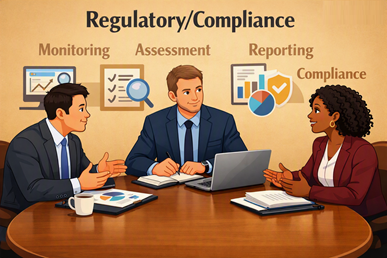
Definition: Regulatory/Compliance is the organizational capability to proactively monitor and assess emerging regulatory requirements and compliance risks, ensuring the company stays ahead of changes through regular audits, risk assessments, and continuous scanning of laws and industry standards. It also requires being responsive, meaning issues are addressed quickly, communication channels are clear, inquiries from regulators are handled promptly, and unresolved compliance concerns receive timely follow‑up. The function develops and implements frameworks, reporting systems, documentation practices, and training programs that translate regulations into effective procedures, accurate reports, well‑maintained records, knowledgeable employees, and strong working relationships with regulatory bodies. Finally, Regulatory/Compliance ensures the organization maintains compliance, mitigates risk, fosters an ethical culture, and demonstrates strong leadership, reinforcing integrity, preventing breaches, and modeling behaviors that uphold both internal standards and external regulatory expectations.
Human Resources
Information Technology/IT
Technology Use/Management
Business Focus
Corporate Culture
Company
Global Perspective
Reorganization
Hiring
Staffing
Turnover
Diversity
Facilities
Resources
Equality
Employee Assistance Program
Employee Development
Employee Relations
Pay
Benefits
Rewards/Recognition
Wellness Program
Example Questionnaires with Regulatory Compliance:
Example 1 (5-point scale; numbers; NA)
Example 2 (7-point scale; radio buttons)
Example 3 (4-point scale; radio buttons)
Example 4 (5-point scale; radio buttons)
Example 5 (5-point scale; words)
Example 6 (Pulse Survey)
Example 7 (5-point scale; item comments)
Example 8 (3-point scale; words; N/A)
Example 9 (4-point scale; numbers)
Example 10 (Comment boxes only)
Example 11 (Single rating per dimension)
Example 12 (Slide-bar scale)
Example 1 (5-point scale; numbers; NA)
Example 2 (7-point scale; radio buttons)
Example 3 (4-point scale; radio buttons)
Example 4 (5-point scale; radio buttons)
Example 5 (5-point scale; words)
Example 6 (Pulse Survey)
Example 7 (5-point scale; item comments)
Example 8 (3-point scale; words; N/A)
Example 9 (4-point scale; numbers)
Example 10 (Comment boxes only)
Example 11 (Single rating per dimension)
Example 12 (Slide-bar scale)
Proactive Monitoring and Assessment
Proactive Monitoring and Assessment is the forward-looking side of Regulatory/Compliance, centered on anticipating risks, detecting issues early, and maintaining continuous oversight. It includes conducting periodic risk assessments, monitoring regulatory changes, performing regular audits, implementing internal controls, coordinating audit procedures, establishing governance structures, and evaluating the effectiveness of compliance programs. This dimension is systematic and preventive--its purpose is to identify exposure, strengthen safeguards, and ensure regulatory changes and compliance strategies are implemented in a timely, structured, and disciplined manner.
- My team assesses the effectiveness of regulatory/compliance programs.
- My supervisor coordinates internal and external audit procedures.
- Coworkers implement regulatory changes in a timely manner.
- Our department performs annual/monthly compliance audits.
- Our organization implements regulatory changes in a timely manner.
- The compliance manager performs regular compliance audits.
- Associates conduct periodic compliance risk assessments to evaluate exposure levels.
- Our department conducts the risk assessments necessary to maintain compliance.
- Colleagues monitor changes in laws, regulations, and industry standards to anticipate new compliance risks.
- I feel confident that I can implement internal control processes to detect misconduct or patterns of illegal transactions.
- The Audit department performs audits regularly, or without notice, to ensure proper compliance with regulations.
- I know how to establish a governance body to monitor and guide the organization's activities.
- My manager implements regulatory compliance strategies.
- I can implement strategies to ensure compliance.
Responsive
Responsive activates when a compliance issue, inquiry, or regulatory change requires immediate attention. It emphasizes timely reaction, clear communication channels, accurate responses to regulators, prompt follow-up on violations, readiness for new rules, and swift action to prevent minor issues from escalating. This dimension is situational and action-oriented--focused on addressing concerns quickly, resolving problems, supporting ethical behavior, and using tools and protocols to track, respond to, and remediate compliance-related issues as they arise.
- The compliance department ensures appropriate followup for regulatory violations.
- There are established communication channels and lines of communication for reporting compliance related issues.
- Clear communication channels and lines of communication are established for compliance related issues.
- Our department maintains a state of readiness to address new and changing regulations and procedures.
- My manager follows up on any unresolved compliance issues.
- The project manager addresses issues quickly before they develop into major problems.
- We use software tools to monitor compliance and track issues to help identify and respond to non-compliance.
- Our department has created a standardized response protocol for responding to compliance related issues.
- Our department responds promptly to inquiries from regulatory bodies.
- Unethical behavior is promptly and consistently addressed.
- My team responds accurately and completely to questions from regulators.
Develops/Implements Frameworks
Develops/Implements Frameworks focuses on building the structural foundation of compliance--creating the policies, procedures, strategies, and governance mechanisms that define how the organization will meet regulatory obligations. This dimension includes developing compliance strategies, establishing secure data-transmission protocols, formulating policies, coordinating compliance activities across departments, creating manuals and reporting channels, and designing incentives or disincentives for compliant behavior. It is broad, architectural, and systems-oriented, emphasizing the creation of durable frameworks that guide behavior, decision-making, and risk mitigation across the organization.
- The compliance officer effectively coordinates the execution of compliance strategies across departments.
- I know how to develop regulatory compliance strategies.
- Changes in regulations are quickly implemented when needed.
- I can develop effective procedures for ensuring compliance.
- Leaders formulate compliance policies and procedures.
- My team develops effective procedures for ensuring compliance.
- My project manager establishes protocols for secure data transmission between departments and external regulators.
- My manager develops strategies to comply with established regulations.
- Our department has investigated risk mitigation strategies.
- The Compliance department observes, monitors and coordinates compliance activities.
- Our department has developed and implemented appropriate reporting channels.
- Our department has created a company compliance manual for distribution to the employees.
- My manager is willing to create the necessary compliance policies and procedures.
- Our department has developed the appropriate incentives (or disincentives) for regulatory compliance.
- We have developed good regulatory compliance strategies.
Develops Reporting System
Develops Reporting System centers on creating the mechanisms that capture, track, analyze, and communicate compliance information. This dimension includes developing compliance reports, maintaining recordkeeping systems, integrating reporting tools with ERP platforms, designing confidential reporting channels, automating data-collection workflows, benchmarking reporting performance, and using reports to evaluate compliance effectiveness and identify risks. It is technical, data-driven, and measurement-focused--ensuring that compliance activities are visible, traceable, accurate, and actionable through well-designed reporting systems.
- My manager uses compliance reports to evaluate the effectiveness of compliance initiatives identifying areas of risk.
- My manager conducts periodic audits of reporting systems to identify discrepancies and improve data integrity.
- The manager has developed and implemented an effecive compliance data recordkeeping system.
- Our department has developed relevant compliance reports to share with our stakeholders.
- Our department develops and implements a compliance data recordkeeping system.
- My supervisor benchmarks reporting system performance against peer organizations to identify improvement opportunities.
- The members of my team integrate reporting systems with Enterprise Resource Planning (ERP) tools to ensure real-time compliance tracking.
- The project leader aligns reporting systems with risk management frameworks to proactively flag compliance gaps.
- Our department maintains a compliance data recordkeeping system.
- I feel the compliance reports have been developed in accordance with federal and industry regulations.
- We use operational compliance reports to evaluate the effectiveness of internal processes.
- The department has developed a confidential reporting system to enable employees to anonymously report safety violations.
- Colleagues develop compliance reports to share with stakeholders.
- We have designed automated workflows to streamline compliance data collection and reporting.
Ensures Compliance
Ensures Compliance is the operational, enforcement-focused side of Regulatory/Compliance, centered on making sure the organization consistently meets legal, regulatory, and industry standards in its daily activities. It involves verifying that data handling meets regulatory requirements, ensuring workflows align with laws, coordinating regulatory responsibilities across departments, completing corrective actions, and allocating resources so compliance functions operate effectively. This dimension is about execution and adherence--making sure regulations are followed, standards are met, and the organization remains compliant across all functions, jurisdictions, and operational processes.
- Data handling meets regulatory standards at the company.
- We ensure regulatory compliance in all activities.
- My manager reviews operations and work flows to ensure compliance with standards.
- Senior executives ensure the company meets legal requirements/standards regarding workers.
- My team leader ensures corrective actions are completed promptly and effectively.
- Our department ensures daily work aligns with regulatory requirements.
- I allocate resources (staffing, training, tools, and time) to ensure the compliance function operates effectively.
- The HR department ensures the company meets legal requirements/standards regarding treatment of employees.
- Our department maintains compliance with federal, state, and local laws.
- Managers ensure that regulatory responsibilities are shared, coordinated, and supported across the organization.
- Managers ensure the company meets legal requirements/standards regarding commercial enterprises.
- My manager ensures the company is in compliance with industry specifications, standards, and applicable laws.
- The project manager ensures regulations are followed as required.
- The supervisor ensures that operations meet government and industry requirements/standards.
- In my department, data handling meets regulatory standards.
- The Compliance department ensures the company is in compliance with all laws regarding the production and transportation of product.
Train and Educate
Train and Educate focuses on building the knowledge, skills, and awareness employees need to comply with regulations. It includes offering training programs, facilitating sessions on reporting tools, explaining regulations, identifying skill gaps, coordinating compliance-officer development, administering certifications, and tracking participation required by industry standards. This dimension is about capability building--equipping employees with the understanding, tools, and confidence to comply with regulations, reduce violations, and strengthen the organization's overall compliance culture.
- The team leader provides training that reduces exposure to regulatory violations.
- Our department has created and implemented effective training courses for new hires to ensure knowledge of regulations and policies.
- My manager trains and coordinates activies of compliance officers.
- Associates are able to complete required certifications, renewals, and compliance training.
- The HR department tracks employee participation in development opportunities as required by industry regulations.
- The compliance officer explains regulations and procedures to others as required.
- Training is offered to employees to ensure they comply with regulations.
- Leaders facilitate training sessions to educate employees on how to use reporting tools effectively.
- Managers review skill levels of employees in areas of policies and regulations to identify gaps where additional training is needed.
- The HR department creates and administers training initiatives on compliance and regulations.
- The HR department offers training to employees to ensure they are complying with regulations.
- The Compliance department offers training on various subjects to help ensure employees are aware of regulations.
- The compliance officer regularly conducts in-house training sessions to promote awareness of regulations and compliance.
Knowledgeable
Knowledgeable focuses on understanding the regulatory landscape--knowing the laws, standards, procedures, and requirements that govern the organization. It emphasizes staying informed through conferences and tradeshows, tracking legislative changes, understanding federal and local regulations, and being familiar with key acts such as EEOC, FLSA, OSHA, and ERISA. This dimension is about possessing accurate, up-to-date regulatory knowledge and ensuring employees, supervisors, and managers understand the rules that shape compliance expectations.
- Team members are kept informed of various regulations and procedures.
- My supervisor is aware of federal and local laws affecting employees.
- Managers are aware of the minimum compliance standards.
- The compliance officer effectively keeps track of changes in legislation affecting regulatory compliance.
- Employees in my department are aware of the required compliance standards.
- Coworkers attend industry tradeshows and conferences to keep up-to-date with changes and trends.
- My manager is familiar with EEOC, FLSA, OSHA and ERISA acts/standards.
- Managers keep up-to-date with legislation affecting employees.
- Supervisors are aware of the documents and reports needed to maintain compliance with regulations.
- The project manager understands the applicable regulations and laws that impact our business.
Working Relationships
Working Relationships emphasizes the interpersonal and collaborative side of compliance--how employees interact with regulators, legal counsel, auditors, and cross-departmental partners. It includes knowing who to contact at regulatory agencies, acting as a liaison, coordinating with legal teams, collaborating with compliance specialists, and maintaining professional, courteous interactions with auditors and regulators. This dimension is about building strong, effective relationships that support compliance activities, facilitate communication, and ensure smooth coordination when regulatory issues arise.
- I have contacts at various regulatory agencies.
- I can act as a liaison to regulatory agencies.
- Supervisors collaborate with legal or compliance teams to evaluate emerging risks.
- Our team interacts with auditors and regulators on a professional basis.
- My manager is professional and courteous in interactions with auditors and regulators.
- I am able to coordinate with legal counsel in conducting audit of legal compliance.
- Coworkers in my department know who to contact at various regulatory agencies if needed.
- My coworkers coordinate with legal counsel if needed when investigating any instances of misconduct.
- Department Managers work together to ensure all are in compliance with established standards and guidelines.
Mitigate Risk
Mitigate Risk focuses on identifying, analyzing, and reducing compliance vulnerabilities before they escalate into violations. It involves assessing high-risk activities, reviewing transactions for misconduct, implementing internal controls, redesigning workflows, correcting deficiencies proactively, and testing controls to ensure they function as intended. This dimension is preventive and analytical--its purpose is to reduce exposure, strengthen safeguards, and stop small issues from becoming regulatory breaches.
- The supervisor redesigns workflows to improve adherence to regulations.
- My manager is proactive--correcting deficiencies before they become compliance issues.
- Team members perform regulatory risk management to manage the risk of compliance (or non-compliance).
- Coworkers identify and assess areas of regulatory or compliance risk.
- Our team tests controls to confirm they are functioning as intended.
- Managers conduct proactive review of policies and procedures to identify gaps that could lead to compliance failures.
- Coworkers in my department identify operational process that create compliance vulnerabilities.
- Our department reviews transactions for potential misconduct.
- Internal controls have been implemented to reduce the likelihood of regulatory breaches.
- Coworkers in my department help prevent minor issues from becoming regulatory breaches.
- The project lead implements recommended mitigation strategies without delay.
- Our team analyzes patterns in past compliance incidents to prevent recurrence.
- Employees understand high-risk activities and how to mitigate the risk.
- Our manager implements internal controls that reduce the likelihood of regulatory breaches.
Fosters Ethical Culture
Fosters Ethical Culture emphasizes shaping the values, behaviors, and norms that guide how employees approach compliance. It includes reinforcing integrity as a core expectation, promoting open dialogue about ethical concerns, helping employees understand ethical implications, distributing codes of conduct, rewarding ethical behavior, and embedding ethics into team goals and daily decision-making. This dimension is cultural and behavioral--focused on creating an environment where employees consistently choose ethical actions, feel safe speaking up, and view compliance as an integral part of how the organization operates.
- The supervisor emphasizes that ethics is embedded in how the team operates, not treated as an afterthought.
- The project lead ensures employees understand the ethical implications of their work.
- Supervisors reinforce the idea that integrity is a key performance expectation, not just a policy requirement.
- Our leaders communicate the importance of meeting compliance standards.
- My department integrates ethical considerations into team goals, performance discussions, and operational planning.
- Managers help strengthen employees' ability to appropriately handle compliance and ethics issues.
- My manager creates and distributes code of ethics and code of conduct.
- Employees in my department understand and adhere to internal and external regulations.
- Managers promote open dialogue about ethical concerns and encourage employees to speak up without fear of retaliation.
- My manager champions a culture of compliance by consistently reinforcing regulatory expectations in team meetings, communications, and decision-making.
- The project manager demonstrates that compliance is not optional but a core expectation for the entire team.
- My team leader ensures compliance through actions and behaviors.
- My supervisor recognizes and rewards employees who demonstrate ethical behavior.
Creates/Maintains Documentation
Creates/Maintains Documentation focuses on generating, organizing, and preserving the records that demonstrate compliance. It includes creating regulatory documents, maintaining up-to-date policies and procedures, documenting audit performance, recording exceptions and corrective actions, and ensuring all materials contain required citations, signatures, and evidence of completion. This dimension is about building and sustaining the documentation infrastructure that supports audits, regulatory reviews, and long-term traceability.
- My manager documents exceptions, corrective actions, and remediation steps in a clear, traceable format.
- Our department creates and maintains necessary regulatory documentation.
- We maintain historical records and documents as needed/required.
- Supervisors document the performance of compliance audits.
- Employees in my department maintain up-to-date versions of all compliance-related policies, procedures, and forms.
- Team members ensure documentation includes required regulatory citations, approval signatures, and evidence of completion.
Reviews Documents
Reviews Documents centers on evaluating the accuracy, relevance, and regulatory alignment of existing documentation. It involves reviewing manuals, reports, policies, and historical records to ensure they meet current standards, identifying outdated materials, analyzing audit findings to strengthen safeguards, and refining reporting methodologies based on trends or new industry expectations. This dimension is about scrutinizing documentation to confirm it remains compliant, useful, and up-to-date, ensuring the organization's records continue to support effective compliance management.
- The supervisor ensures outdated documents are promptly replaced and archived.
- My manager reviews the compliance program and recommends changes based on new industry trends.
- Our manager reviews historical compliance reports to identify trends and refine reporting methodologies.
- The project manager reviews anti-retaliation policies to ensure compliance with government standards.
- My manager reviews documentation and procedures manuals to ensure regulatory compliance.
- Our team reviews documentation, processes and practices.
- Audit findings are used to strengthen compliance safeguards.
Provides Documentation
Provides Documentation focuses on producing and supplying the records that regulators, auditors, and internal stakeholders need to verify compliance. It involves creating reports, submitting certification applications, maintaining organized documentation repositories, keeping detailed compliance records, preparing annual reports, and ensuring required documents are easy to locate and complete. This dimension is about delivering the evidence of compliance--the tangible materials that demonstrate regulatory adherence and support audits, inspections, and certification processes.
- My department keeps detailed records of compliance measures.
- Coworkers provide documents and reports as needed to maintain compliance with laws.
- Our manager creates standardized templates for recurring compliance reports to ensure consistency, completeness, and alignment with regulatory expectations.
- Managers submit complete applications for necessary certifications.
- Associates create documents and reports as needed to maintain compliance with regulations.
- My team ensures auditors, inspectors, and internal stakeholders are able to quickly locate required records.
- My coworkers maintain organized, accessible documentation repositories.
- Employees in my department provide regulators with complete records.
- Our team prepares and presents annual reports as required.
Complies with Regulations
Complies with Regulations emphasizes performing daily work in a manner that meets legal, regulatory, and organizational requirements. It includes following safety procedures, adjusting departmental practices to align with regulations, using approved tools and methods, protecting confidential information, avoiding shortcuts, reporting violations, and ensuring tasks with regulatory implications are completed accurately. This dimension is about behavior and adherence--consistently acting in accordance with laws, policies, and standards so the organization remains compliant in its operations.
- I am able to verify that documentation, reporting, and record-keeping practices meet regulatory expectations.
- My department avoids unauthorized shortcuts or non-compliant practices.
- Coworkers adjust departmental practices accordingly to maintain compliance with regulations.
- My coworkers follow all safety regulations and procedures.
- Coworkers in my department comply with regulatory requirements for the state.
- Team members follow organizational policies, procedures, and operational guidelines.
- Our team complies with trade agreements affecting international companies.
- Team members maintain confidentiality and protect sensitive information in accordance with privacy laws and organizational policies.
- The project manager reports potential compliance violations, safety hazards, or irregularities.
- The team leader performs tasks that have regulatory implications, such as documentation, reporting, inspections, or data entry.
- We use approved tools, systems, and methods when performing regulated activities.
- Managers act in compliance with all federal, state, and local laws.
- My supervisor adjusts departmental practices accordingly to maintain compliance with regulations.
Leadership
Leadership reflects the strategic, culture-setting role leaders play in shaping how compliance is understood, prioritized, and practiced across the organization. It involves modeling ethical decision-making, setting expectations that violations will not be tolerated, providing oversight and direction, guiding employees through complex regulations, holding people accountable, and leading cross-departmental collaboration to address compliance risks. This dimension is about influence, tone, and governance--leaders create the environment, expectations, and supervisory structures that make compliance a core organizational value.
- Our manager leads cross-departmental collaboration to address compliance risks.
- Leaders model ethical decision-making in daily actions and choices.
- Senior leaders hold employees and supervisors accountable for meeting compliance standards.
- Leadership sends employees a clear message that violations of ethical standards will not be ignored or minimized.
- My manager holds employees and supervisors accountable for meeting compliance standards.
- The oversight panel provides comprehensive supervision for the organization.
- My manager provides clear guidance when interpreting complex regulations, helping employees understand how rules apply to real-world operational situations.
- The appointed supervisory committee ensures effective oversight of the organization.
- My manager sets the tone in the department that compliance is a strategic priority.
- Managers provide direction and oversight for the compliance department.