Flexibility - Competency
Definition: Flexibility is the ability to think a variety of thoughts, change the ways of doing things, solving unique problems, meeting the needs of a variety of people, managing unpredictable events/circumstances, and adapting to new environments or the needs of different situations. Flexibility also includes recovering quickly from setbacks and maintaining a high level of productivity despite obstacles. Flexibility includes being responsive to the needs of others, to accommodate others, and provide customized training to facilitate learning.
Flexibility
Adaptability
Creativity
Accountability
Action
Bias for Action
Commitment
Integrity
Excellence
Self Management
Passion To Learn
Continual Learning
Creativity
Professional Development
Feedback
Punctuality
Attitude
Cultural Awareness
Emotional Intelligence
What is Flexibility as a Competency?
Core Components of Flexibility:
Why is Flexibility important?
How can I improve flexibility skills?
What are the benefits of being flexible in business?
360-Feedback questions that measure Flexibility
Core Components of Flexibility:
Why is Flexibility important?
How can I improve flexibility skills?
What are the benefits of being flexible in business?
360-Feedback questions that measure Flexibility
Self-Comments: Do you have to complete a self-assessment or performance appraisal? If so, the
self-comments here may help.
self-comments here may help.
360-Feedback Questionnaires Measuring Flexibility:
Survey 1 (4-point scale; Competency Comments)
Survey 2 (4-point scale; Competency Comments)
Survey 3 (5-point scale; Competency Comments)
Survey 4 (5-point scale; radio buttons)
Survey 5 (4-point scale; words)
Survey 6 (4-point scale; words)
Survey 7 (5-point scale; competency comments; N/A)
Survey 8 (3-point scale; Agree/Disagree words; N/A)
Survey 9 (3-point scale; Strength/Development; N/A)
Survey 10 (Comment boxes only)
Survey 11 (Single rating per competency)
Survey 12 (Slide-bar scale)
Survey 13 (4-point scale; numbers; floating anchors)
Survey 14 (4-point scale; N/A)
Survey 1 (4-point scale; Competency Comments)
Survey 2 (4-point scale; Competency Comments)
Survey 3 (5-point scale; Competency Comments)
Survey 4 (5-point scale; radio buttons)
Survey 5 (4-point scale; words)
Survey 6 (4-point scale; words)
Survey 7 (5-point scale; competency comments; N/A)
Survey 8 (3-point scale; Agree/Disagree words; N/A)
Survey 9 (3-point scale; Strength/Development; N/A)
Survey 10 (Comment boxes only)
Survey 11 (Single rating per competency)
Survey 12 (Slide-bar scale)
Survey 13 (4-point scale; numbers; floating anchors)
Survey 14 (4-point scale; N/A)
Performance Management Assessments
that include Flexibility:
Assessment 1 (5-point scale; IDP Comments)
Assessment 2 (3-point scale with Comments)
Assessment 3 (Manager Assessment; 360-Feedback)
Assessment 4 (3-point scale; Rating Limits)
Assessment 5 (3-point scale; Rating Limits)
Assessment 6 (5-point scale with Comments)
Assessment 7 (Comment Boxes Only; IDP)
Assessment 8 (Comment Boxes Only)
Assessment 9 (3-point scale with Letter Grade)
Assessment 10 (360-Feedback; Bonus/Merit Pay)
Assessment 11 (Core Values & Job Competencies)
Assessment 12 (4-point scale; 6 Comment Boxes)
that include Flexibility:
Assessment 1 (5-point scale; IDP Comments)
Assessment 2 (3-point scale with Comments)
Assessment 3 (Manager Assessment; 360-Feedback)
Assessment 4 (3-point scale; Rating Limits)
Assessment 5 (3-point scale; Rating Limits)
Assessment 6 (5-point scale with Comments)
Assessment 7 (Comment Boxes Only; IDP)
Assessment 8 (Comment Boxes Only)
Assessment 9 (3-point scale with Letter Grade)
Assessment 10 (360-Feedback; Bonus/Merit Pay)
Assessment 11 (Core Values & Job Competencies)
Assessment 12 (4-point scale; 6 Comment Boxes)
What is Flexibility as a Competency?
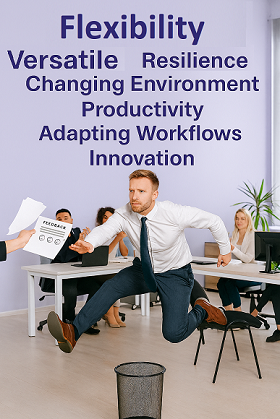
Flexibility is the capacity to adapt one's thinking, approach, and behavior in response to new information, diverse perspectives, and evolving circumstances. It begins with flexibility of thought, where individuals readily incorporate multiple viewpoints, balance competing considerations, and shift mental frameworks to find common ground or innovative solutions. This cognitive agility supports flexible problem solving, enabling people to explore alternative approaches, integrate new ideas from others, and adjust their reasoning as situations unfold. Flexibility also shows up interpersonally through flexibility with others, where individuals accommodate scheduling needs, adjust expectations, and support colleagues by adapting to personal or operational constraints.
Flexibility further involves the ability to adjust processes, workflows, and methods in response to changing demands. Individuals demonstrate flexibility in process by modifying procedures during critical incidents, integrating new tools or technologies without disruption, and adapting workflows to meet new regulations, equipment changes, or organizational requirements. This operational adaptability is strengthened by versatility--the ease with which someone shifts across tasks, environments, and client needs--and by responsiveness, which reflects the ability to change behavior quickly when customer needs, external requests, or unexpected challenges arise. In dynamic or uncertain environments, flexible individuals remain steady and effective, maintaining productivity, increasing output when needed, and tailoring their approach to meet situational demands.
At its core, Flexibility is sustained by resilience, innovation, and a commitment to continuous improvement. Resilient individuals bounce back from setbacks, treat challenges as opportunities to learn, and remain effective during rapid change. They innovate by thinking creatively, experimenting with new methods, and generating solutions to unforeseen problems. Through continuous improvement, they stay current with industry trends, refine their skills, and evolve their practices to meet emerging challenges. Flexibility also extends to customized training, strategic adaptation, and working style adjustments, where individuals tailor onboarding, shift leadership approaches, modify strategies based on new information, and adjust goals or agendas to reflect changing priorities. At the organizational level, flexibility is demonstrated through adapting to new structures, policies, and procedures, and through evolving business processes to support long-term effectiveness and growth.
Flexibility further involves the ability to adjust processes, workflows, and methods in response to changing demands. Individuals demonstrate flexibility in process by modifying procedures during critical incidents, integrating new tools or technologies without disruption, and adapting workflows to meet new regulations, equipment changes, or organizational requirements. This operational adaptability is strengthened by versatility--the ease with which someone shifts across tasks, environments, and client needs--and by responsiveness, which reflects the ability to change behavior quickly when customer needs, external requests, or unexpected challenges arise. In dynamic or uncertain environments, flexible individuals remain steady and effective, maintaining productivity, increasing output when needed, and tailoring their approach to meet situational demands.
At its core, Flexibility is sustained by resilience, innovation, and a commitment to continuous improvement. Resilient individuals bounce back from setbacks, treat challenges as opportunities to learn, and remain effective during rapid change. They innovate by thinking creatively, experimenting with new methods, and generating solutions to unforeseen problems. Through continuous improvement, they stay current with industry trends, refine their skills, and evolve their practices to meet emerging challenges. Flexibility also extends to customized training, strategic adaptation, and working style adjustments, where individuals tailor onboarding, shift leadership approaches, modify strategies based on new information, and adjust goals or agendas to reflect changing priorities. At the organizational level, flexibility is demonstrated through adapting to new structures, policies, and procedures, and through evolving business processes to support long-term effectiveness and growth.
Core Components of Flexibility:
- Flexibility of Thought: openness to new perspectives and adaptability in thinking. This dimension highlights the ability to embrace diverse viewpoints, incorporate fresh ideas, and maintain an open mind when encountering new information.
- Flexibility in Process: adjusting workflows, procedures, and systems to enhance efficiency and adaptability. This dimension highlights the ability to modify established methods, integrate new technologies, and improve operational processes in response to evolving demands.
- Flexible Problem Solving: adaptability in approaching and resolving challenges. This dimension centers on modifying solutions based on new information, responding to issues with creativity, and considering alternative approaches to overcome obstacles.
- Flexibility with Others: adapting to the needs, perspectives, and requests of employees and stakeholders. This dimension centers on accommodating schedules, listening to input, fostering collaboration, and creating an inclusive culture where individuals feel supported during transitions.
- Dealing with Uncertainty: navigating unpredictable situations with resilience and creative problem-solving. This dimension highlights the ability to embrace ambiguity, remain productive despite uncertain circumstances, and proactively adjust to evolving challenges.
- Versatile: adaptability across a variety of tasks, settings, and needs. This dimension centers on adjusting approaches to fit unique scenarios, responding to diverse challenges, and fostering agility in processes and decision-making.
- Resilience: the ability to recover from setbacks and maintain stability in unpredictable situations. This dimension highlights persistence, learning from challenges, and remaining proactive when faced with adversity.
- Changing Environment: the ability to continuously adapt to evolving circumstances, systems, and external conditions. This dimension centers on transitioning smoothly between different environments, adjusting strategies based on market shifts, and remaining agile in response to unforeseen changes.
- Productivity: maintaining and increasing efficiency in response to evolving demands. This dimension highlights the ability to scale production, handle fluctuations in workload, and deliver a diverse range of goods and services while sustaining effectiveness.
- Adapting Workflows: modifying processes and procedures to accommodate changes in the work environment. This dimension highlights the ability to adjust workflows due to evolving regulations, resources, technology, or operational needs.
- Innovation: creating entirely new solutions and driving forward-thinking improvements. This dimension centers on experimentation, developing fresh ideas, fostering a culture of creativity, and introducing groundbreaking products or processes.
- Continuous Improvement: ongoing learning and refinement of processes to enhance efficiency and innovation. This dimension highlights the ability to seek out new knowledge, integrate evolving techniques, and create a work culture that embraces flexibility and continuous enhancement.
- Customized Training: tailoring training methods to accommodate different learning styles and unique employee needs. This dimension centers on adapting onboarding, modifying instructional approaches, and fostering an inclusive environment where training is personalized for maximum effectiveness.
- Responsiveness: quick and proactive reactions to changing circumstances and needs. This dimension highlights agility in addressing market shifts, customer demands, schedule changes, and organizational needs.
- Accommodative: willingness to adjust and modify behaviors or environments to better support changes. This dimension centers on smoothly integrating personnel shifts, workplace modifications, and evolving operational demands while maintaining a cooperative and adaptable mindset.
- Strategic: adjusting approaches, tactics, and decision-making to align with new challenges or opportunities. This dimension centers on pivoting strategies, modifying processes, and evaluating organizational direction to ensure long-term adaptability.
Why is Flexibility important?
Flexibility allows individuals and organizations to adapt to changing circumstances and challenges with ease. This adaptability enhances problem-solving, strategic thinking and innovation, leading to more effective and efficient operations. Flexibility is being resilient in the response to setbacks, enabling a quicker recovery and maintaining productivity. Flexibility also accommodates the diverse needs and perspectives of others to create a more inclusive and collaborative work environment. Flexibility helps drive success and sustainability in today's dynamic business environment.
How can I improve flexibility skills?
- Perspectives and Assumptions: Actively seek out and consider diverse perspectives and be open to adjusting your viewpoints when presented with new information. Embrace change by experimenting with new ideas and methods, and continuously challenge your own assumptions.
- Continuous Learning: Stay updated with the latest industry trends, tools, and technologies. Regularly attend workshops, webinars, and training sessions. This additional information will help you to expand your capabilities to be able to solve a wider variety of problems.
- Embrace Change: Cultivate a positive attitude towards change. Instead of resisting new procedures or methods, view them as opportunities to improve and innovate.
- Seek Feedback: Encourage and actively seek feedback from colleagues and team members. Keep an open mind and be willing to consider suggestions and ideas from others. Use this feedback constructively to improve and adapt your processes and procedures.
- Experimentation: Be willing to test out new ideas and approaches. Don't be afraid to deviate from the norm to find more efficient or effective ways of doing things.
- Collaboration: Engage with a diverse group of people and value their perspectives. Collaborative efforts often lead to more adaptable and resilient processes.
What are the benefits of being flexible in business?
- Perspectives and Assumptions: Expanding perspectives allows companies to consider a broader range of ideas and solutions, fostering innovation and creativity. By challenging assumptions, businesses can identify and eliminate outdated or incorrect beliefs, leading to more accurate decision-making and adaptive strategies. This openness to new viewpoints and willingness to question the status quo enable organizations to respond swiftly to changes in the market, seize emerging opportunities, and maintain a competitive edge.
What questions could you consider for including on a 360-degree feedback assessment regarding Flexibility?
360-Feedback questions that measure Flexibility
Flexibility of Thought
Flexibility of Thought centers on mental openness--being willing to consider different viewpoints, integrate new ideas, and adjust thinking when presented with new information. It involves valuing diverse perspectives, balancing multiple angles to find common ground, and encouraging creative or "outside-the-box" approaches. This dimension reflects cognitive adaptability: the ability to shift perspectives, rethink assumptions, and remain receptive to innovative solutions.
- Open to the perspectives/viewpoints of others.
- Willing to try new ideas.
- Effective in incorporating new ideas.
- Demonstrates flexibility in thoughts and actions.
- Is open to and values diverse perspectives.
- Promotes flexibility in approaches by encouraging employees to think outside the box and experiment with new methods and ideas.
- Is flexible in considering different viewpoints.
- Adapts easily to incorporate various perspectives.
- Balances multiple perspectives to find common ground and innovative solutions.
- Maintains an adaptive mindset crucial for navigating the dynamic challenges and opportunities that arise in business environments.
- Thinks outside the 'box'.
- Willing to change ideas or perceptions based on new information or contrary evidence which is presented.
- Keeps an 'open' mind and looks for new opportunities.
Flexibility in Process
Flexibility in Process focuses on adapting how work gets done. It involves adjusting procedures, workflows, and methods in response to changing circumstances, new technologies, or evolving organizational needs. This dimension emphasizes practical adaptability--modifying processes, learning new systems, integrating updated tools, and encouraging others to adopt improved ways of working. Flexibility in Process is about operational agility.
- Is open to change and new ways of doing things.
- Encourages others to adopt new procedures.
- Adapts quickly to new technologies that impact the production line.
- Able to adapt processes in response to critical incidents that impact the workflow.
- Is flexible in processing routine requests.
- Able to integrate the latest tools and methods without causing disruption.
- Willing to learn new processes and systems.
- Willing to deviate from rigid plans and consider a variety of methods, ensuring the most effective solution is applied.
- Regularly assesses current methods, welcomes feedback, and is willing to implement changes to improve efficiency and effectiveness.
- Willing to implement new procedures for the department.
Flexible Problem Solving
Flexible Problem Solving focuses on adapting how you approach the problem itself. It involves shifting strategies when new information emerges, trying alternative methods when the current solution isn't effective, and responding to obstacles with creativity and innovation. This dimension is about cognitive and analytical agility--modifying solutions, exploring different approaches, and considering ideas offered by others to resolve issues more effectively. The emphasis is on adjusting the problem-solving method to fit changing circumstances.
- Willing to try new approaches to solving problems if the current solution isn't working.
- Is flexible in solving difficult problems.
- Is able to change their approach to solving a problem based on new information.
- Modifies solutions based on new information.
- Considers alternative approaches to overcome obstacles.
- Responds to issues and problems with creative solutions and innovation.
- Considers other solutions provided by employees.
- Responds to issues with creativity.
- Integrates new ideas and information into solutions and processes.
- Solves problems using innovative solutions by keeping an open mind and considering the input from others.
Flexibility with Others
Flexibility with Others focuses on adapting to people. It involves accommodating the needs, perspectives, and requests of employees, adjusting schedules or work arrangements, and incorporating others' viewpoints into decisions. This dimension emphasizes interpersonal adaptability--listening actively, responding to individual circumstances, and making changes based on employee input. The emphasis is on adjusting interactions and support to foster cohesion, responsiveness, and a collaborative team environment.
- Adapts to the needs, perspectives, and requests of employees in the department.
- Permits flexible working and flex-time to accommodate employee needs to meet external obligations.
- Actively listens to others, considers their viewpoints, and incorporates these insights into the decision-making process.
- Accommodates the needs of employees as best as possible when requests for time off are made.
- Implements changes as a result of having listened to employees
- Builds a more engaged and cohesive team willing to pivot and support each other through transitions and changes.
- Accommodates adaptable scheduling.
- Accommodates the needs of employees when requests for time off are made.
- Encourages open communication and collaboration, allowing everyone to contribute their ideas and perspectives.
- Responds quickly to the needs of others.
Dealing with Uncertainty
Dealing with Uncertainty focuses on performing well when the situation itself is unstable, unpredictable, or unclear. This dimension emphasizes staying productive and composed amid ambiguity, responding confidently to unexpected events, and experimenting with new methods when the path forward isn't obvious. It reflects comfort with chaos--embracing change, adapting to shifting technologies or financial conditions, and helping the team remain agile when circumstances are volatile. The core idea is navigating the unknown: turning unpredictable situations into opportunities for innovation and growth.
- Navigates ambiguity with ease, maintaining focus and productivity amidst uncertainty.
- Able to deal with uncertain and unpredictable events.
- Is flexible in dealing with unpredictable events.
- Embraces uncertainty with confidence and creativity to find solutions amidst chaos.
- Faces the unknown head-on, turning challenges into opportunities for growth and innovation.
- Fosters a culture of agility, ensuring that the team can thrive amidst constant change and uncertainty.
- Embraces change, values feedback, and is willing to experiment with different methods to find the most effective solutions.
- Is flexible to manage uncertain changes in the financial landscape.
- Is flexible to manage uncertain changes in technology.
- Able to anticipate or adapt to uncertain or changing situations.
Versatile
Versatile focuses on adapting across different contexts, tasks, and demands. It emphasizes shifting approaches to fit the unique requirements of each scenario, responding effectively to a wide variety of issues, and performing well in different settings or roles. This dimension reflects breadth and agility--coping with diverse client needs, adjusting processes to be more efficient, and fostering adaptability in decision-making. The core idea is range: being able to pivot smoothly between tasks, environments, and challenges, not just uncertain ones.
- Agile and versatile when dealing with issues.
- Agile and versatile when responding to critical issues.
- Adjusts approaches to fit unique scenarios.
- Is versatile and resilient.
- Able to adapt and tailor approaches based on the unique requirements of each scenario.
- Fosters an environment that prioritizes adaptability, ongoing enhancement, and creative thinking.
- Encourages adaptability to utilize more efficient processes.
- Ability to cope with a variety of client needs.
- Effectively manages changes in financial resources.
- Adapts to different settings, tasks, and challenges with ease.
- Fosters agility in processes and decision-making.
- Fosters a culture of flexibility and agility.
- Responds to diverse challenges.
- Is able to perform new tasks and assignments.
Resilience
Resilience is about how a person responds after a setback or disruption. It focuses on the ability to bounce back, regain stability, and stay effective when obstacles arise. This dimension emphasizes recovering quickly, staying proactive during critical incidents, and maintaining performance even when environments become unpredictable. The core idea is endurance: remaining steady, composed, and capable of moving forward despite challenges or adversity.
- Is able to recover from setbacks.
- Flexible and resilient in addressing critical incidents.
- Is able to bounce back from obstacles.
- Is resilient and proactive to help thrive in unpredictable environments.
- Embraces issues as opportunities to learn and grow.
- Remains calm when dealing with multiple issues.
Changing Environment
Changing Environment is about how a person adapts as conditions evolve. It emphasizes adjusting behaviors, decisions, and approaches in response to new situations, shifting market demands, emerging technologies, or unfamiliar circumstances. This dimension reflects situational agility--acting decisively in uncertain environments, transitioning smoothly between different contexts, and revising ideas or perceptions based on new information. The core idea is adaptability: staying effective by evolving with the environment rather than simply recovering from disruptions.
- Adapts to circumstances as needed.
- Able to adapt to new situations.
- Flexible in handling unforeseen circumstances.
- Quickly adapts to new circumstances, challenges, or opportunities as they arise.
- Acts decisively in frequently changing and uncertain environment.
- Works effectively during periods of change.
- Recognizes and quickly adapts to shifts in the environment, market, or industry.
- Anticipates differences to the procedures that may be needed due to a changing operating environment.
- Able to work in multiple environments as needed.
- Willing to change ideas or perceptions based on new information.
- Can seamlessly transition between various environments and situations.
- Flexible in adjusting to the demands of the market place.
- Open to adapting thoughts, behaviors, and strategies in response to evolving situations and new information.
- Adapts to new technology and systems.
Productivity
Productivity focuses on output flexibility--the ability to maintain or increase production levels, deliver a wide range of goods or services, and adjust capacity as demands change. This dimension emphasizes scaling up when needed, handling fluctuations in volume, and staying effective regardless of context. It reflects performance agility: producing more, producing differently, or producing across varied business needs without losing effectiveness. The core idea is flexible capacity--adapting what you produce and how much you produce to meet shifting organizational demands.
- Capable of delivering a diverse range of goods and services to meet various business requirements.
- Able to produce goods and services across a wide spectrum of business needs.
- Able to produce a wide range of products/services to meet demands.
- Scales up production capabilities in response to growing service demands.
- Flexible in effectively handling changes in production volumes.
- Able to maintain productivity and effectiveness no matter the context.
- Delivers a variety of products that vary in type and volume.
- Expands productive capacity as demand for services increases.
- Performs more and varried processes on the production line.
- Able to increase output to meet increased demand.
Adapting Workflows
Adapting Workflows focuses on process flexibility--changing how work is done when circumstances shift. This dimension emphasizes modifying procedures, adjusting workflows midstream, accommodating new regulations or policies, and evolving processes in response to changes in equipment, supplies, or the work environment. It reflects operational agility: altering steps, systems, and methods to stay aligned with new requirements. The core idea is flexible methods--adapting the workflow itself rather than the volume or range of output.
- Adapts processes and procedures in response to changes in the work environment.
- Able to change the workflow as needed to facilitate changes in regulations or policies.
- Adapts workflows according to changing needs.
- Allows workflows to evolve with the employees' creativity.
- Capable of adapting workflows to accommodate new regulations or policies.
- Adapts to new procedures.
- Able to change or adjust processes to accommodate changes in equipment or supplies.
- Able to make changes midstream into current tasks or projects.
- Able to change ways of working as needed.
Innovation
Innovation focuses on creating something new--developing original ideas, experimenting with unconventional approaches, and generating novel solutions to unforeseen problems. This dimension emphasizes thinking outside the box, modifying behaviors to stay adaptable, and encouraging a culture where experimentation is welcomed. Innovation is about breakthrough thinking: introducing new products or services, responding creatively to issues, and adjusting thought processes to remain flexible and inventive.
- Creates innovative solutions to unforeseen problems.
- Innovates skills and modifies behaviors to remain flexible in addressing important issues.
- Introduces new products or services.
- Demonstrates the ability to think outside the box and adjust as needed.
- Encourages a culture of experimentation and innovation.
- Demonstrates adaptability in innovative thought processes.
- Experiments with new ideas to create innovative solutions to issues.
Continuous Improvement
Continuous Improvement focuses on making things steadily better over time. It emphasizes learning new techniques, refining existing processes, staying current with industry trends, and seeking ongoing opportunities to enhance efficiency and effectiveness. This dimension is iterative rather than disruptive: incorporating new skills smoothly, updating workflows as situations evolve, and fostering a culture where improvement is a daily habit. Continuous Improvement is about progression--small, consistent enhancements that strengthen performance and adaptability.
- Focuses on continuous improvement strategies.
- Seeks opportunities to improve processes and procedures to benefit the department.
- Continuously learning and adapting new techniques to address evolving challenges.
- Actively seeks out new knowledge, staying updated with industry trends, and is open to changing the workflow based on the situation.
- Supports a flexible culture that values continuous improvement and innovation.
- Incorporates new skills fluently.
- Supports a culture that values flexibility, continuous improvement and innovation.
- Learns from personal experiences and/or mistakes.
- Learns from personal experiences and/or mistakes and integrates experience to cope with new or untried events.
Customized Training
Customized Training focuses on tailoring learning experiences to the individual. It involves adapting training methods, materials, formats, and onboarding processes to meet each employee's unique learning style, needs, and circumstances. This dimension emphasizes personalization--modifying delivery for visual, auditory, or kinesthetic learners; offering virtual or in-person options; creating individualized schedules; and fostering an inclusive environment where everyone feels supported. The core idea is customized development: shaping training so each person can learn effectively and contribute productively.
- Adapts training delivery to enhance effectiveness and create an inclusive environment, boosting team cohesion and productivity.
- Modifies training methods and materials to suit visual, auditory, and kinesthetic learners.
- Adapts training delivery to maximize learning.
- Fosters an inclusive learning environment where everyone feels supported.
- Adapts the onboarding experience to meet the unique needs of each new employee.
- Creates personalized training schedules, offering various learning formats (like virtual and in-person sessions), and provides tailored training resources.
- Ensures that each employee's unique learning style is accommodated.
- Adapts to different learning styles of employees as required to make sure employees receive the highest level of training.
- Values and adjusts training to meet diverse learning preferences.
- Encourages flexibility in the onboarding process.
Responsiveness
Responsiveness focuses on reacting quickly and effectively to changing conditions, needs, or requests. It emphasizes agility in addressing unexpected challenges, shifting market conditions, customer needs, schedule changes, resource availability, regulatory updates, and departmental demands. This dimension is situational rather than instructional--responding promptly, anticipating challenges, and taking preemptive action to stay aligned with evolving circumstances. The core idea is adaptive reaction: adjusting behaviors, priorities, and decisions in real time to meet emerging needs.
- Exhibits exceptional adaptability in responding to unexpected challenges.
- Remains agile and responsive to address changing needs in a dynamic environment.
- Responds effectively to changes in the market conditions.
- Is flexible in responding to customer needs.
- Responds to changing governmental regulations.
- Responds positively to unanticipated changes in the work schedule.
- Swiftly adapts to changes, anticipates challenges and takes preemptive actions.
- Responds to the various needs of other colleagues and departments.
- Responds to changing availability of supplies and resources.
- Handles external information requests efficiently without disrupting workflow.
- Changes behavior quickly based on the task or needs of the customer.
- Responds quickly to new opportunities or risks.
Accommodative
Accommodative focuses on adjusting smoothly to immediate, practical changes in the work environment. It reflects a willingness to modify behaviors, accept new conditions, and accommodate shifts in personnel, workflows, or expectations without resistance. This dimension is grounded in day-to-day adaptability--being agreeable, cooperative, and ready to optimize when circumstances change. The core idea is responsiveness to operational needs: making necessary accommodations so work continues effectively and without disruption.
- Is able to make accommodations needed for changes to the working conditions.
- Shows a readiness to adapt and optimize.
- Capable of adjusting to necessary modifications in the work environment.
- Can handle changes without complaining.
- Can easily accommodate changes in personnel of the department.
Strategic
Strategic focuses on adapting at the level of direction, priorities, and long-range decision-making. It involves pivoting strategies, operations, or processes in real time based on new information, emerging challenges, or opportunities. This dimension is forward-looking and analytical--evaluating situational demands, anticipating shifts, and adjusting the overarching approach to ensure success. The core idea is intentional recalibration: changing the plan itself, not just accommodating conditions, to stay aligned with evolving goals and environments.
- Adapts strategies to fit the specific needs of each situation.
- Changes strategies based on new information.
- Pivots strategies, operations, or processes in real-time to meet new challenges or seize new opportunities.
- Selects strategies according to the demands of the situation.
- Will pivot strategies, operations, or processes in real-time to meet new challenges or seize new opportunities.
- Willing to change strategies, operations, or processes in to meet new challenges or seize new opportunities.
- Changes strategies as needed.
- Embraces change and is willing to pivot strategies based on new information.
- Continually evaluates the direction and speed of the organization and makes appropriate mid-course adjustments
Working Style
- Able to make changes to their leadership style after receiving constructive feedback through the performance review.
- Adjusts working style to meet client needs.
- Adjusts managerial style to meet the needs of the department.
- Changes their approach in response to new information.
- Adjusts working style to meet the demands of the situation.
Goals
- Is open to alternative ways to accomplish goals
- Allows for flexibility in setting realistic performance goals.
- Allows for flexibility in the agenda for the team meeting.
- Identifies new opportunities to achieve goals
Organizational Flexibility
- Adapts to new organizational structures, policies, or procedures.
- Dedicated to evolving and enhancing business processes.
- Successfully implemented the changes proposed in the re-organization.
- Responds to a changing organization.
- Re-organized the functions in the department.